


Corporate Event Budget: Hidden Costs to Plan For
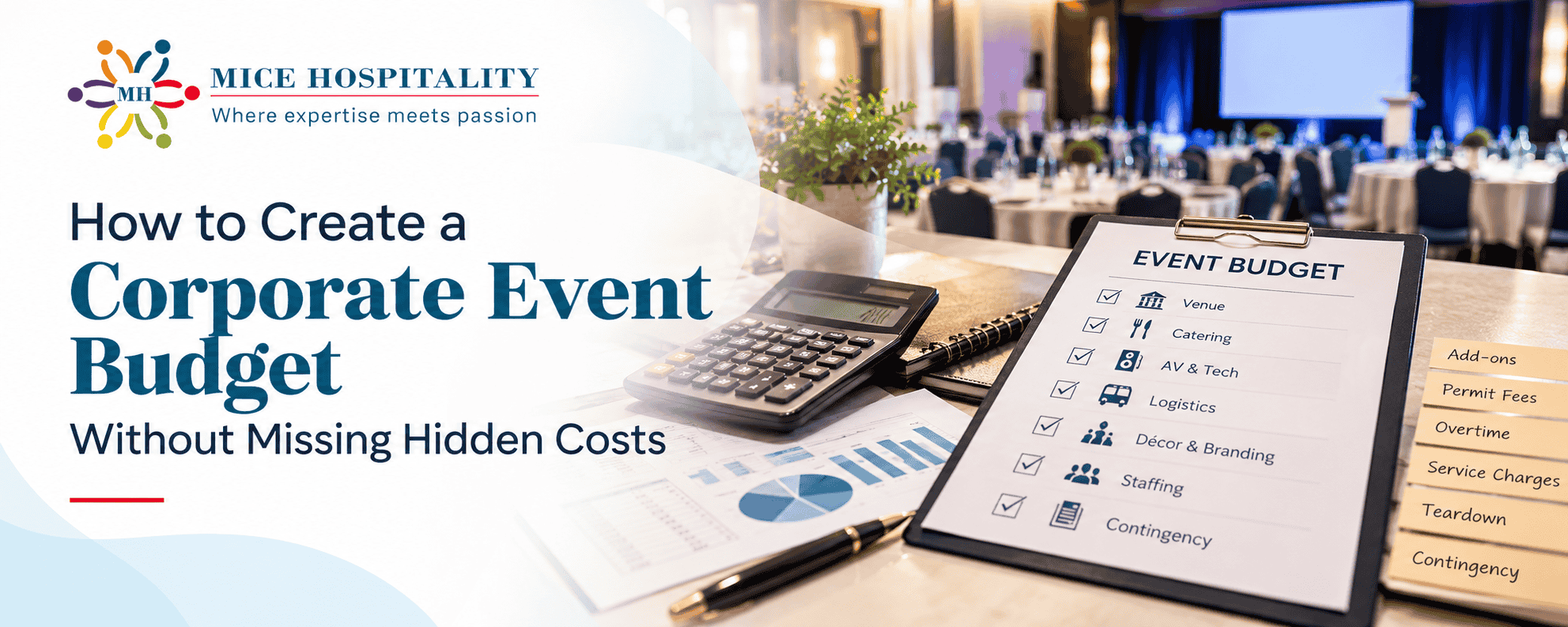
Table of contents
A corporate event budget only works if it accounts for the costs that don't show up on a vendor's first quote. Venue rent, catering, and AV get quoted upfront, so they're easy to plan around. The ones nobody mentions until the invoice lands overtime charges, décor teardown, a last-minute vendor swap, a permit fee, are the ones that break the numbers. Corporate event budgeting has to cover both from the start, not patch the gaps once the event is already booked.
Mice Hospitality has managed corporate travel and event budgets across India for over a decade. What separates a budget that holds from one that doesn't usually comes down to whether hidden costs were priced in before the contract was signed, not after.
What Goes Into a Corporate Event Budget
Most corporate event planning budgets stop at the first six rows and skip the last one entirely. That single gap is where most event planning costs go over.
Weighting shifts by event type too; a large-scale conference leans heavier on AV, staffing, and multi-day logistics than a single-venue offsite does, so the same seven categories carry different weight depending on what you're actually running.
The Hidden Costs Most Corporate Event Planners Miss
This is the section worth bookmarking, because these are the charges that turn a tight event budget breakdown into a scramble for approvals two days before the event.
- AV overage charges: Quoted AV packages usually cover a fixed number of hours. Run over, and the per-hour rate jumps, sometimes by 30-40%.
- Vendor gratuities and service fees: Catering and staffing quotes often list a base rate and a separate service charge that gets added at invoicing, not at booking.
- Decor teardown: Setup is priced. Teardown, especially same-night teardown, frequently isn't, and venues charge for the crew time to clear it.
- Permits and insurance: Outdoor events, certain venues, and events with alcohol service often need permits or liability coverage that don't appear on a standard venue quote.
- WiFi and tech add-ons: Dedicated bandwidth for a conference with 100+ attendees is rarely included in base venue WiFi, and providers charge separately for guaranteed speed.
- Last-minute vendor changes: A vendor cancellation two weeks out means paying a premium for a replacement, on top of whatever deposit was already lost.
- Food waste buffer: Catering is priced per head, but headcounts shift. Most experienced planners build in a 5-8% buffer rather than ordering to the exact RSVP count.
On a recent 100-person group tour Mice Hospitality managed, three of these seven categories showed up as unplanned line items for the client's internal team before the trip. All three were already built into the working budget, which is the difference between a manageable adjustment and a last-minute funding request.
Step-by-Step Guide: How to Build a Realistic Event Budget
This is the approach Mice Hospitality applies to every managed event: quotes get itemised before approval, and contingency gets built in as a line item, not an afterthought.
Start with the event goal, not the venue. A client dinner for 30 and a 500-person conference need different budget structures even at similar total spend.
List every category from the table above, including the ones you don't have a number for yet.
Get itemised quotes, not bundled ones. A bundled quote hides which line items carry the overage risk.
Set contingency at 10-15% of total spend, not 10-15% of the venue cost alone. Contingency scaled only to venue is one of the most common corporate event cost mistakes.
Confirm what "included" actually means with every vendor, in writing, for AV hours, teardown, and staffing.
Review the budget against the hidden-cost list before final sign-off, not after the event is booked.
How to Avoid Budget Overruns
Overruns usually trace back to vague vendor inclusions and headcounts that change after catering is already locked. Both are fixable before the contract stage. Check every quote against the hidden-cost list before signing, and keep a 5-8% buffer on headcount instead of ordering to the exact RSVP number. Contingency helps too, but only if it's set against total spend rather than just the venue line, which is where a lot of budgets quietly underfund it.
Group travel runs into a different version of the same problem. Mice Hospitality's recent 60-person tour to Sri Lanka, a family trip rather than a corporate offsite, is a good example: transport and accommodation coordination carried more of the budget risk than AV or staging ever would on an event that size. A smaller team outing follows the same pattern at a smaller scale, so it needs to be budgeted around group size and destination rather than forced into a conference-style template.
Ready to Build a Budget That Doesn't Break Mid-Event?
A corporate event budget that accounts for hidden costs from the start saves both money and last-minute stress. Getting the line items, contingency, and vendor terms right before signing is what separates a smooth event from a scramble for approvals.
Planning a conference, team outing, or large-scale event and want the budget built right the first time?
Get in touch with Mice Hospitality.
FAQs
Should GST and service charges be included when comparing event vendor quotations?
Yes. Always compare final, all-inclusive quotes. Base rates without GST and service charges hide 15-20% cost differences and make cheaper vendors look misleadingly affordable.
What should be included in a corporate event budget?
Venue, catering, AV, logistics, décor, staffing, and contingency. Skipping contingency is the most common gap that causes budgets to run over mid-event.
Is in-house event planning actually cheaper than hiring an event management company?
Rarely, once staff time, vendor markups, and missed hidden costs are counted. Agencies use existing vendor relationships to offset their fee.
What costs can increase when the final guest count changes?
Catering, seating, printed materials, and staffing ratios all scale with headcount. A 5-8% buffer absorbs most last-minute count changes.
How do you create a budget for a corporate event?
List every cost category, get itemised vendor quotes, add 10-15% contingency on total spend, and confirm inclusions in writing before signing.

Planning something similar?
Share a few details and our team will come back with a tailored proposal.



 Conference Organizer
 Event management
 Team Outing
 Travel Planner
 Wedding Planning